
Too perfect: repeated patterns and copy-paste symmetry in AI images
Nature repeats with variation. Generated images sometimes repeat without it.
Models generate textures by learning patterns, and they sometimes repeat them too exactly: identical leaves, cloned clouds, the same face twice in a crowd, a row of fruit where every piece is the same size.
Composition can be suspiciously balanced too. A centred subject, a perfect rule-of-thirds horizon, and a background that frames it neatly can make an image feel like a stock photo of a stock photo.
Paired details fail in both directions. Eyes, ears and earrings can come out as exact mirror copies, or they do not match at all: a hoop on one ear and a stud on the other. Real pairs match in design and differ in how they hang, crease and catch the light.
Checklist
- Look for clones in crowds, leaves, bricks and food.
- Check whether paired things like earrings and shoes are mirror copies, or do not match at all.
- Compare the two halves of a face: hairline, eyebrows, ears and the corners of the mouth.
- Ask whether the composition is too neat for the situation.
False alarms
Mass-produced objects are identical in real life too. Supermarket shelves, tiled walls and rows of seats are full of clones. Portraits lit straight from the front also hide the small differences between the two halves of a face.
Examples from past puzzles
These photos ran in earlier puzzles. In each one, this tell decided the answer or confirmed it. For real photos it is the detail that shows a camera was there.
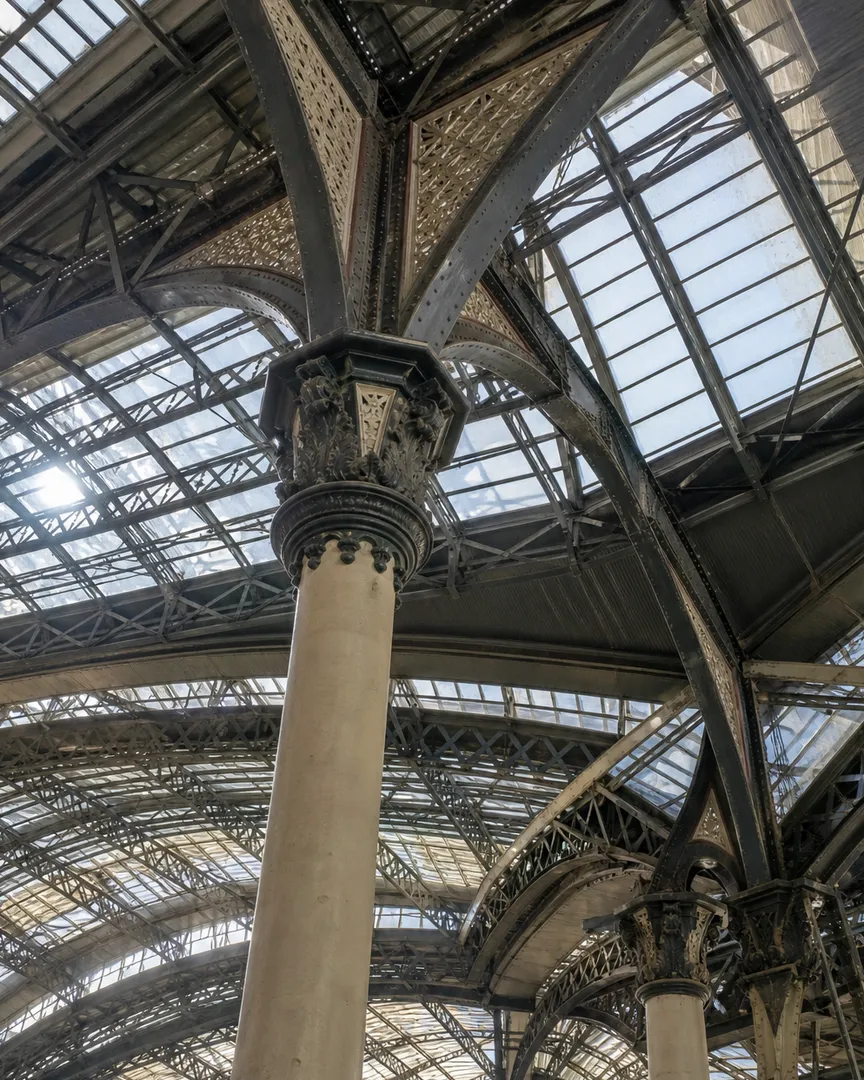
AI image
The repeating geometric patterns in the metal arches become irregular and lose their symmetry upon close inspection.
Made with GPT Image 2.
Test yourself
Put it into practice in the daily AI or Real game or the endless quiz.